Domestic Septic Tank Regulations

Is your septic tank compliant?

We’ve compiled this comprehensive guide on the updated septic tank and domestic wastewater regulations that came into force. Our guide will help you to determine what your obligations are and if you need to replace your existing septic tank with a new sewage treatment plant.
Please also obtain the correct professional/legal advice where necessary.

Check Check

Is my septic tank compliant or do I need to replace it

Thumbs-up Thumbs-up

What is classed as a legal discharge of wastewater

Home Home

What happens if I am selling my house with a septic tank

The current situation

The homeowner, under the code of practice by the Environment Agency, is responsible for the installation, maintenance and impact that the property’s sanitation and wastewater system may have on the environment.

New regulations are in place in both England and Wales in order to prevent any water pollution as a result of wastewater.

Since 2015 all septic system discharging directly to water are illegal, such as:

  • To surface water drain
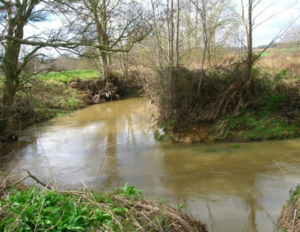
  • To rivers
  • To streams
  • To canals
  • Or any other type of watercourse

If you are in a situation such as those listed above, you will have to upgrade your existing septic tank to align with the new environmental rules.

The Environment Agency set the deadline of the 1st January 2020 for all domestic households that use a septic tank to become compliant.

So, in simple terms if you have a septic tank that currently discharges to a stream, river or any other watercourse you will either need to upgrade to a sewage treatment plant or change the discharge to a drainage field.

The deadline does not impact homeowners with a septic tank that discharges to ground, soakaway or a drainage ditch.

What is new within the 2020 regulations?

2020 is the deadline by which you have to update, or replace, your sewage treatment plant if it does not align with the regulations outlined under the Environment Agency’s “General Binding Rules.

The 2020 sewage treatment regulation applies directly to England and Wales from 2015 onwards.

More information about the binding rules are available on this government page: Septic tanks and treatment plants: permits and general binding rules

What is a septic tank?

A domestic septic tank usually consists of two round concrete tanks with lids placed close to each other. They are connected by a pipe. A septic tank can also be a single rectangular concrete tank with a dividing wall in it.

A septic tank settles the solids in the wastewater and then discharges the liquid septic waste to the ground through a well-designed and made drainage field.

There are many regulations that govern how septic tanks are to be constructed, positioned and installed. If you have a specific septic tank that discharges to surface water (i.e. a river, stream, ditch, etc.) you are required to upgrade or replace your septic tank treatment system to a full sewage treatment plant by 2020.

If your septic tank was installed before 1983, you won’t necessarily need to replace the tank if the current means of discharge meets the new regulations and/or if a permit is required. If however, the tank is unsafe or damaged you will need to replace it with a sewage treatment plant.

Is my septic tank compliant?

If you’re not sure if your septic tank complies with the new regulations the first thing you can do is to find out where your current system discharges to.

We’d recommend having a look around the perimeter of the property to see if there a ditch or river, etc. If you cannot see one it is unlikely you discharge to one.

If you’ve just moved in to your property you could also speak to your neighbours to ask if they have a septic tank and if they know where theirs discharges to.

What is classed as a legal discharge?

RiverA legal discharge of domestic wastewater is one of the following:

  • A discharge from a septic tank to a drainage field designed and made compliant with British Standard 6297:2007
  • A discharge from a sewage treatment plant compliant with British Standard EN 12566-3 that is maintained annually with an associated effluent quality test

What are my obligations and responsibilities?

The first obligation is that your treatment system must follow the new British Standards (BS) regarding sanitation installations, such as: BS EN 12566 for all the small sewage treatment plants BS 6297:2007 for all the drainage fields

Your treatment plant is suitable if it met the British Standards when you installed the product, which is applicable:

  • If it is CE Marked and has the CE label and kitemark on it
  • If your installation has a certificate of conformity
  • If it is on British Water’s list of approved equipment for sanitation

What is a domestic sewage treatment plant?

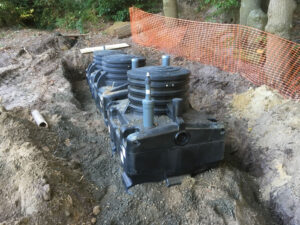
Tanks in position, concreted, awaiting pea beach. Site: Ashurst Wood, West Sussex

A sewage treatment plant is a system that holds sewage in an input tank allowing water to overflow into a treatment plant where water is treated allowing clean water output at gravity feed or pumped into the water course, stream, ditch or drainage field.

View our case studies of sewage treatment plant installations for customers in East and West Sussex.

What size sewage treatment plant do I need?

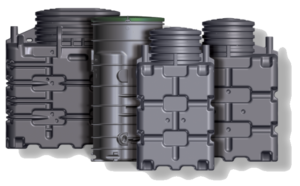
Biorock Ecorock treatment plantYou must have a product adapted for the size of your house, so your sewage treatment must have enough capacity to handle the maximum amount of wastewater that your home will produce.

For example: If your house has the capacity for five individuals (PE 5), you will have to install a suitable sewage treatment system which can cater to this volume.

You can find guidance on how you choose your tank size in relation to usage capacity within this BCA PDF document: Guidance on sizing of Package Sewage Treatment Plants

*For further details and other information please consult: British Water’s Flows and Loads 4 guidance.

If you decide to upgrade your current system, you will need then to follow the sizing requirements outlined by the British Water’s Flows and Loads 4 guidance documents (link above).

For example, if you want to extend your property (add more rooms or connect another house), you will have to check if your sewage system can handle the extra load as a result of the extension. If the data states that it will not, you will have to upgrade your system. You will have to maintain your system.

All sewage systems require yearly maintenance in order to protect both the product and the environment, this is essential. If you own a sewage treatment system, you will need to get it serviced and desludged by a professional in-line with the manufacturers guidance and advice.

The sludge removed must be taken and disposed of by a registered professional.

What happens if my treatment plant is not functioning correctly?

If your treatment system is not functioning correctly (odours & smells, leaks, etc.) you will have to get it repaired. When your tank requires fixing or maintenance, please select a professional that has knowledge of your own particular system.

What happens if I’m selling my house with a septic tank?

Please remember, if you sell your house with a sewage treatment system you will have to provide the future owner with the full details of the installation (date of installation, maintenance dates, technical interventions and so on).

Lastly, if the sewage treatment system is not in use anymore, you are obliged to remove it without causing any pollution.

Post 2020 there is an increased onus on the discharge owner to ensure that any wastewater discharge is compliant with the regulation.

You will not be able to sell your house without documentation of service, a compliant discharge and a properly installed and functioning system.

There is some further useful information contained within this article on the RenovateMe website: Septic tanks: How will the new regulations affect my property?

What are my options to meet the 2020 regulations?

Option 1: Connect your house to the public sewer. How do you know if you can? You need to contact your local water company. If you have a public sewer near your house, you will have to check if you can connect to it. You will be able to connect your home if you are within a 30-meter distance a from the public sewer pipe.

Option 2: Check if you can install an infiltration system on your property. However, you need to be aware that this process is also under regulation and requires a lot of space.

Option 3: Upgrade your installation with a sewage treatment plant. This solution does not require much space and complies with local regulations.

Why choose us to install your sewage treatment plant?

Green Septic Solutions are specialist sewage treatment plant installers. We carry out domestic installs of the BIOROCK systems across East & West Sussex and parts of Kent. If you are unsure about the wastewater regulations please get in touch and we’d be happy to answer any questions.

BIOROCK benefits

Be aware that the new regulations have unfortunately attracted a lot ‘cowboys’ into the wastewater drainage sector employing sales people to sell treatment plants that don’t meet the British Standard EN 12566-3 nor comply with the new regulations.

Our advice is to ask to meet the engineer who will be doing the install and ask him to provide evidence that the install will meet all the required standards and be 100% compliant.

At Green Septic Solutions we go a step further. We offer all potential new customers the opportunity to accompany us to a site where we have installed a compliant sewage treatment plant for a customer, before they sign-off on an installation project with us. You will get the opportunity to see the system in-situ and ask us questions.  We also visit your property to carry out an on-site survey before we providing you with a quote.

Please check out our customer case studies and reviews or get in touch if you’d like to discuss a sewage treatment plant installation project with us.